Breaking the Silence: Survivors Secure Landmark Settlement in Asheville School Sexual Abuse Cases
For decades, the prestigious campus of Asheville School—an elite North Carolina boarding prep school where annual tuition eclipses $74,000—maintained an untarnished reputation as one of the country’s premier educational institutions. But beneath the surface of this historic campus lay a dark history of institutional betrayal.
Following a grueling four-year legal battle, that history has finally been forced into the light.
A major legal victory has been achieved for five alumni who came forward to expose historical Asheville School sexual abuse. Documents filed in Buncombe County Superior Court confirm that a comprehensive settlement has been reached to address the long-ignored legacy of Asheville School sexual abuse at the private boarding high school.
The litigation over this widespread Asheville School sexual abuse was brought forward by the joint legal teams of Rawls, Scheer, Clary & Mingo, and Paul Mones LLC. Together, they represented four survivors of severe Asheville School sexual abuse dating back to the mid-1960s, along with a fifth individual who alleged systemic negligent supervision, training, and retention related to Asheville School sexual abuse perpetrated by a faculty member employed at the school in the early 1990s.
A Toxic Campus Environment Exposed
The initial complaints filed by the survivors paints a chilling picture of systemic institutional failure. The lawsuits alleged that the predatory behavior and Asheville School sexual abuse began when some of the victims were as young as 13 years old. Because Asheville School operates as a residential boarding program, several of the students were forced to live in the exact same campus dormitories as the faculty members who were actively subjecting them to Asheville School sexual abuse.
The civil complaints sought both compensatory and punitive damages for lifelong physical, psychological, and emotional injuries caused by Asheville School sexual abuse. Crucially, the lawsuits did not merely target individual perpetrators; they aimed directly at the institution’s leadership. The filings alleged that administrators possessed knowledge of the predatory behavior, yet actively “created a toxic school environment, and was wanton, reckless, tolerant, and deliberately indifferent to the abuse.”
Despite the severity of the allegations regarding Asheville School sexual abuse, none of the staffers involved were ever criminally prosecuted. This left civil litigation as the only viable path for survivors to achieve real institutional accountability.
In a joint statement addressing the resolution of these tragic cases of Asheville School sexual abuse, plaintiffs’ attorneys Amanda Mingo, Katie Clary, and Paul Mones strongly commended their clients’ immense bravery. They emphasized that coming forward and “seeking change in the face of the painful events” was an incredibly difficult act that has caused each survivor lifelong trauma.
The Legal Catalyst: The North Carolina SAFE Child Act
This historic resolution of decades-old Asheville School sexual abuse would have been completely impossible just a few years ago. Traditionally, North Carolina had some of the most restrictive statutes of limitations in the country, giving child sexual abuse survivors only until the age of 21 to file a civil lawsuit against their abusers or negligent organizations.
That dynamic shifted dramatically with the unanimous passage of the 2019 North Carolina SAFE Child Act. While the law permanently extended the standard statute of limitations to age 28, its most revolutionary feature was a temporary two-year “lookback window.” This window, which ran from January 1, 2020, through December 31, 2021, allowed adult survivors of childhood abuse—regardless of how long ago the crimes occurred—to revive previously time-barred claims and sue for civil damages.
The lookback provision opened the floodgates for justice across the state, prompting hundreds of civil claims. It allowed survivors to target predatory teachers, coaches, pastors, and scout leaders, as well as powerful institutions like churches, summer camps, and the Daniel Boone Council of the Boy Scouts for failing to protect vulnerable children. It was inside this exact legislative window that the lawsuits exposing Asheville School sexual abuse were filed.
Defending Wealth: The Institutional Pushback
Asheville School, which operates as a wealthy nonprofit entity with tax records indicating nearly $106 million in assets, did not accept accountability easily. Throughout the multi-year litigation over Asheville School sexual abuse, the prep school’s legal defense relied on a highly controversial argument: claiming that the lookback window of the SAFE Child Act was unconstitutional.
This specific constitutional defense is currently the subject of an intense legal battle before the North Carolina Supreme Court. In a parallel case involving the Gaston County Board of Education and a former coach convicted of statutory rape, school boards and defense attorneys are arguing that reviving expired statutes of limitations violates the state constitution.
Despite using this aggressive defense strategy to fight the alumni for years, Asheville School ultimately chose to settle the claims before a definitive Supreme Court ruling could wipe out the survivors’ path to justice. While the specific financial details and terms of the final agreement remain strictly confidential under the settlement filed with prejudice, the resolution forces an elite institution to financially account for its past history of Asheville School sexual abuse.
Forcing Institutional Change
While no amount of financial compensation can erase the trauma of childhood exploitation, the conclusion of the Asheville School sexual abuse litigation marks an important turning point for student safety in private education.
In public statements following the court filing, Asheville School administrators acknowledged that they have been forced to “learn from the victims’ stories.” Head of School Anthony Sgro stated that the institution has committed itself to extensive programming designed to prevent internal abuse from ever occurring on their campus again.
For the legal advocates who stood beside these five alumni through years of painful litigation, the settlement represents a vital step toward a safer educational landscape.
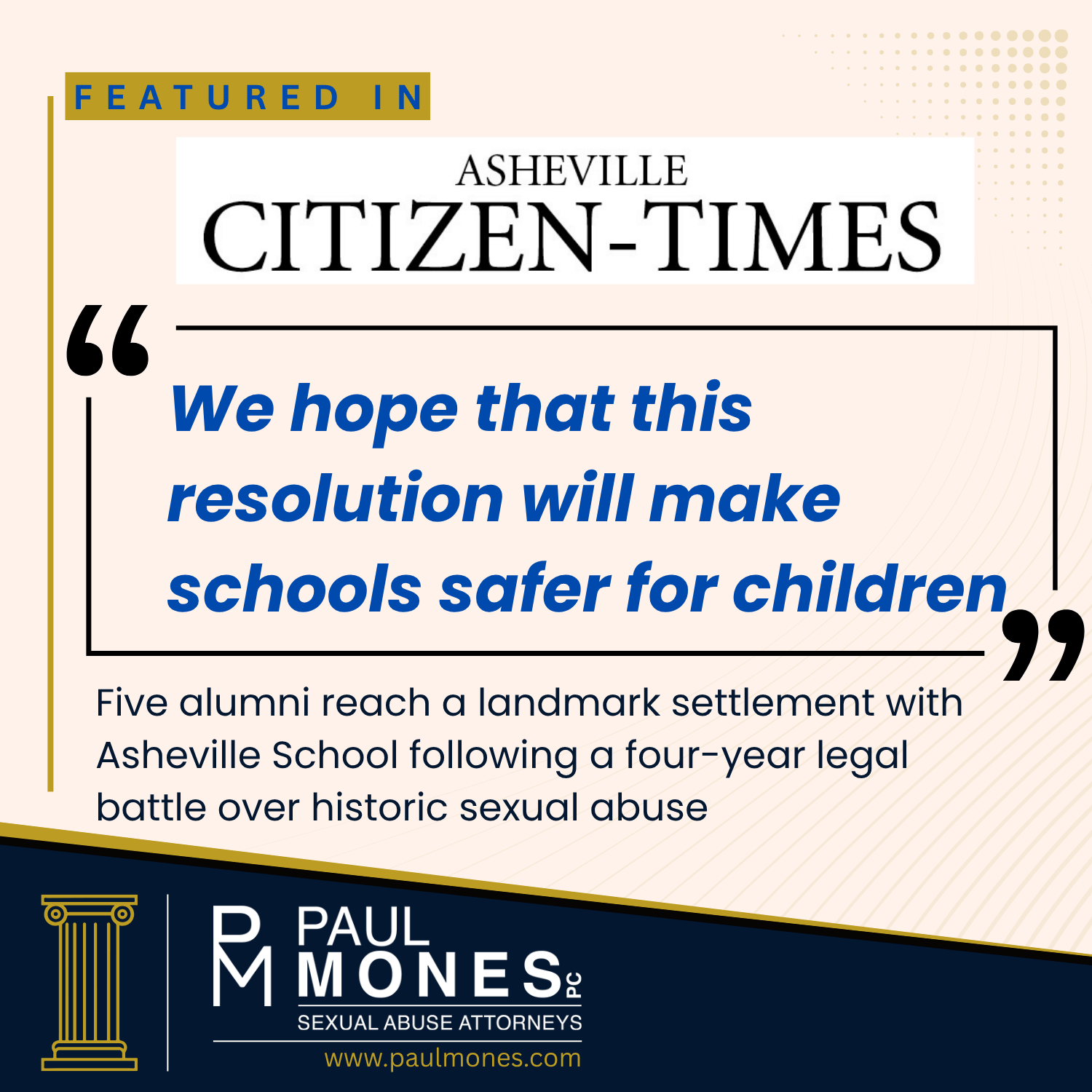
“We acknowledge the decisions and efforts by Asheville School to resolve these matters,” stated the plaintiffs’ legal team, including Paul Mones. “We hope that this resolution will make schools safer for children.”
The message sent by this settlement to boarding schools and private academies nationwide is unmistakable: historical prestige and massive asset pools will no longer shield an institution from the legal consequences of protecting predators over children.
Seeking Justice and Accountability
If you or a loved one is a survivor of historical childhood sexual abuse at a private boarding school, academy, or youth organization, your path to accountability is still open. Powerful institutions must be held responsible for the environments they created.
Contact Paul Mones, PC today for a fully confidential, compassionate, and free case consultation.