The Billion-Dollar Shield: Deconstructing the Fight Over Boy Scouts of America Bankruptcy Assets
When the national council of the Boy Scouts of America officially sought refuge within the federal insolvency framework, it triggered one of the most complex corporate restructurings in United States history. While executive leadership framed the Chapter 11 filing as a compassionate step toward establishing a unified survivor compensation fund, mass tort litigators quickly identified a more defensive strategic motive. The core battleground immediately shifted to the valuation, preservation, and division of the Boy Scouts of America bankruptcy assets.
For decades, the youth organization functioned under a highly decentralized structural model. When multi-state civil lookback windows opened—allowing historical child abuse survivors to file lawsuits regardless of how much time had passed—the national organization faced a crippling wave of litigation. Entering bankruptcy court allowed the national council to establish a global legal shield, effectively freezing thousands of independent state lawsuits while attempting to carefully ring-fence the true extent of the broader Boy Scouts of America bankruptcy assets.
The Structural Divide Between National and Local Wealth
At the absolute center of the reorganization dispute was a stark financial discrepancy. Financial disclosures revealed that while the national Boy Scouts council possessed roughly $1.4 billion in direct holdings, its affiliated regional local councils controlled an additional, massive $3.3 billion in real estate and investments. This multi-billion-dollar empire became the main target for victims’ advocacy coalitions seeking to maximize the pool of Boy Scouts of America bankruptcy assets.
The national office initially argued that because the 260+ regional local councils operated as independent non-profit corporations, their local wilderness camps, historic endowments, and commercial real estate portfolios should be completely excluded from the national pool of Boy Scouts of America bankruptcy assets. However, attorneys representing thousands of survivors countered that these regional entities were fully integrated into the rubric of the national brand. Because the local councils directly appointed, managed, and failed to report the predators operating within local troops, advocates insisted their wealth must be factored into the final recovery equation.
Suppressing the Public Ledger vs. Preserving Capital
Beyond the preservation of physical property, legal experts identified another critical motivation behind the timing of the bankruptcy: controlling the public release of highly damaging internal records. Prior to the restructuring, plaintiffs’ lawyers nationwide were aggressively unearthing the organization’s secret “ineligible volunteer files”—often called the perversion files. These documents proved that the organization had cataloged roughly 12,000 victims of abuse while routinely shielding perpetrators from local law enforcement.
The financial conflict primarily centered on three distinct areas of wealth:
- National Council Holdings: Approximately $1.4 billion in assets that were immediately integrated into the core liquidation pool.
- Local Council Property Empires: Roughly $3.3 billion in regional holdings that were aggressively targeted by survivor coalitions and subject to intense contribution fights.
- Corporate Insurance Policies: A highly variable, multi-billion-dollar pool of historic coverage that became the subject of decades-old coverage disputes and long-term litigation.
By consolidating thousands of active claims into a single bankruptcy venue, the organization successfully avoided facing hundreds of individual state-court trials. In a standard civil trial, plaintiffs’ attorneys would easily introduce these secret ledgers into the public domain. Preventing a nationwide public disclosure of these files was a top corporate priority, as widespread public exposure would have severely damaged the remaining value of the Boy Scouts of America bankruptcy assets by destroying corporate sponsorships and future enrollment numbers.
The Unprecedented Scale of Harm: Mass tort experts emphasize that this restructuring is entirely unprecedented in size and scope. While over twenty Catholic dioceses have previously utilized bankruptcy to resolve abuse claims, none possessed the vast, parallel network of regional property and multi-million-dollar local endowments that define the true scale of the Boy Scouts of America bankruptcy assets.
Channelling Claims and the Strict Bar Date Mechanism
The immediate mechanism of the Chapter 11 shield was the implementation of an automatic stay, which instantly halted all ongoing civil litigation against the national council. This shifted the burden of proof directly onto the survivors. To receive even a fraction of compensation from the pooled Boy Scouts of America bankruptcy assets, every individual—including those who had already won or filed independent lawsuits—was legally required to submit a detailed, formal proof of claim directly to the bankruptcy court.
This process introduced a rigid court-ordered deadline known as a bar date. Under federal bankruptcy rules, missing this administrative timeline meant a survivor’s legal rights were permanently extinguished, barring them forever from pursuing future claims against the organization or accessing any portion of the Boy Scouts of America bankruptcy assets. For tens of thousands of men carrying decades of repressed childhood trauma, this bureaucratic framework forced an incredibly difficult, fast-paced choice between confronting their past or losing their legal rights forever.
The Long-Term Reality of the Settlement Trust
Ultimately, the restructuring process resulted in the creation of a massive, multi-billion-dollar Scouting Settlement Trust. This entity was designed to absorb contributions from the national council, local councils, and participating insurance companies, creating a centralized pool of Boy Scouts of America bankruptcy assets dedicated exclusively to survivor restitution.
However, translating these nominal asset valuations into actual financial payouts remains an ongoing, highly complex administrative challenge. The trust utilizes strict, tiered evaluation formulas to assess the severity, duration, and institutional knowledge surrounding each individual report. As these evaluation processes continue, the historic battle over the Boy Scouts of America bankruptcy assets stands as a stark warning of how institutional failures can completely shatter a multi-billion-dollar legacy.
Secure Elite Representation for Your Trust Claim Evaluation
The formal filing deadlines for the bankruptcy restructuring have closed, and the battle has fully shifted to the internal distribution and matrix review phase of the Scouting Settlement Trust. If your filed claim is currently undergoing detailed valuation, or if you are facing intricate inquiries regarding your structural tier assignment, securing aggressive legal representation is essential to protecting your rights. Our dedicated practice focuses entirely on auditing trust actions, unlocking hidden regional contributions, and ensuring your history is evaluated for maximum restitution under the guidelines controlling the remaining Boy Scouts of America bankruptcy assets.
Contact Paul Mones, PC today to schedule a completely confidential, compassionate case review.
Source Information
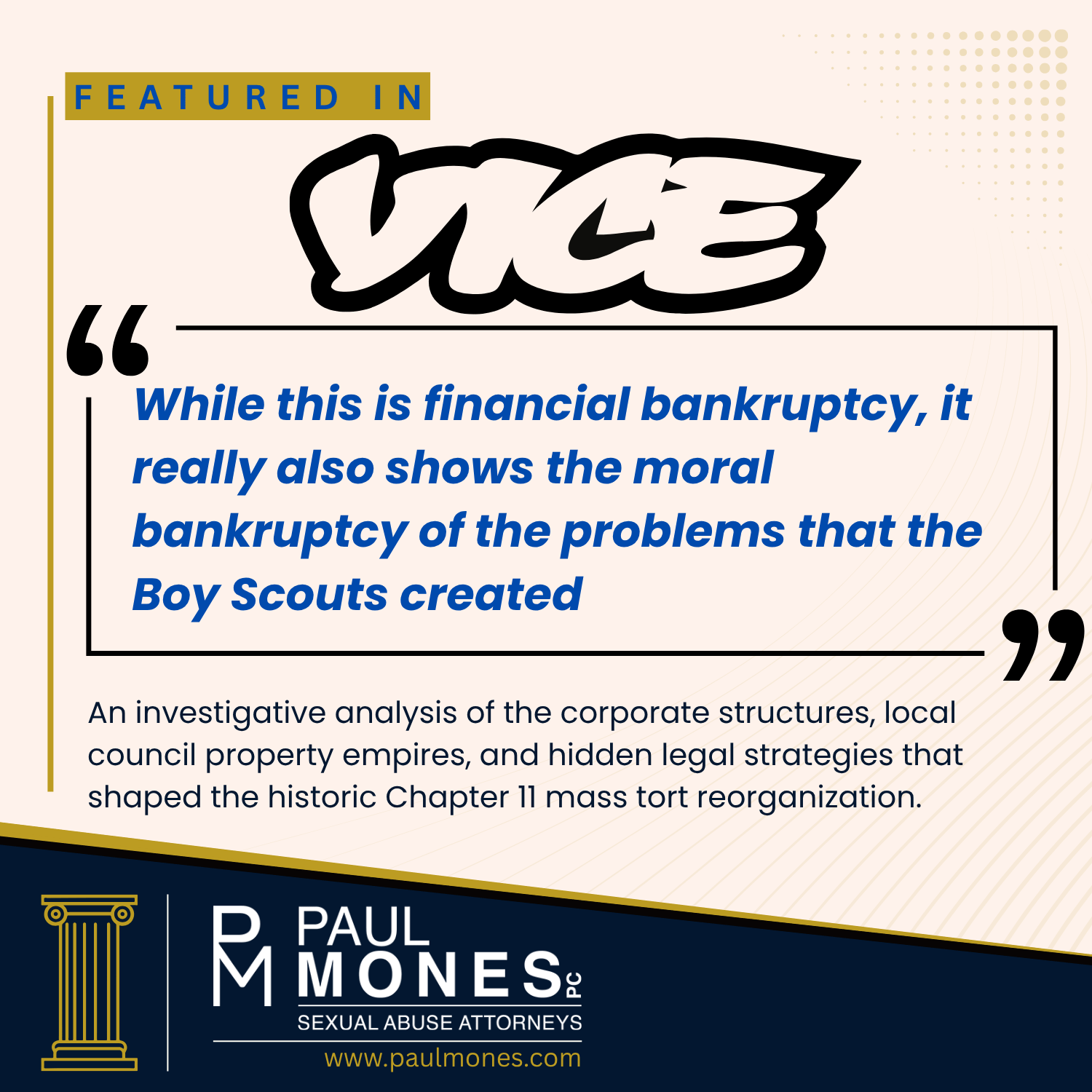
To explore the early financial reporting, asset analyses, and breaking journalistic timelines surrounding this historic Chapter 11 filing, review the comprehensive coverage published by VICE News here.