The New Abuse Crisis: How Catholic Dioceses Use Bankruptcy to Evade the Child Victims Act
For decades, survivors of institutional child sexual abuse fought an uphill battle to secure their day in court. In states across the nation, that relentless advocacy culminated in historic legislative victories like New York’s Child Victims Act (CVA). These landmark look-back windows temporarily lifted or completely eliminated civil statutes of limitations, granting survivors a vital legal pathway to hold predatory individuals and negligent institutional leadership fully accountable.
Yet, precisely as hundreds of survivors bravely stepped forward to seek the transparent justice they had been denied for decades, the Catholic Church hierarchy deployed a highly coordinated, aggressive legal counter-strategy nationwide. That counter-strategy relies heavily on triggering a corporate clergy sex abuse bankruptcy filing.
A sweeping investigative report published by The Free Press exposes the dark inner workings of this legal maneuver. It reveals how dozens of dioceses are actively utilizing federal Chapter 11 protections to trigger a strategic clergy sex abuse bankruptcy process, halting civil lawsuits in their tracks, freezing the critical pre-trial discovery process, keeping institutional “secret files” permanently hidden from public view, and ultimately pressuring aging victims into accepting pennies on the dollar.
The Strategic Pivot from Civil Justice to “Debt Restructuring”
When a state legislature passes look-back windows, civil juries routinely prove to be highly sympathetic to survivors of childhood trauma. Juries possess the legal authority to award multi-million dollar verdicts that accurately reflect the catastrophic, lifelong psychological and physical damage caused by institutional exploitation. Furthermore, a traditional civil trial takes place in an open courtroom, subjecting the defendant to intense public scrutiny and forcing the cross-examination of bishops, cardinals, and diocesan administrators.
To eliminate this threat of public accountability, at least 41 Catholic dioceses and religious orders across the United States have voluntarily chosen to file for Chapter 11 reorganization. By intentionally executing a clergy sex abuse bankruptcy strategy, a diocese successfully and fundamentally alters the entire paradigm of the legal battle:
- The Automatic Stay: The exact moment a diocese submits a voluntary bankruptcy petition, an immediate, absolute legal halt is placed on all pending and ongoing civil lawsuits. The survivor’s constitutional right to a jury trial is instantly erased.
- The Erasure of Discovery: The reorganization process effectively terminates the standard civil discovery process. Survivors’ legal teams are completely blocked from subpoenaing internal communications, disciplinary records, and institutional cover-up tracking sheets.
- Victims Reclassified as “Creditors”: The federal bankruptcy framework is explicitly engineered to preserve, protect, and save the debtor. Consequently, survivors are legally stripped of their identity as victims of heinous physical crimes and are reclassified as mere “unsecured creditors” fighting for a small piece of a strictly capped pool of financial assets.
For survivors navigating this landscape, understanding how a clergy sex abuse bankruptcy alters their statutory rights is vital.
“Bankruptcy eviscerates the whole architecture for ferreting out the truth,” explains Paul Mones, a pioneering plaintiff’s attorney who has spent decades representing dozens of survivors entangled in these complex maneuvers. “By removing cases from the civil justice system, there is no cross-examination of church hierarchy, and all the ways to tease out the injurious behavior of church abusers gets whitewashed. It’s all about how much money the entity has to distribute, and nothing else. Lawyers are reduced to being financial managers.”
Weaponized Delay: The Tragic Legal Strategy of Attrition
Perhaps the most devastating real-world consequence of a clergy sex abuse bankruptcy filing is the agonizing timeline it imposes on victims. Chapter 11 mediations and restructuring negotiations routinely drag on for four, five, or even six years in federal court. For an abuse survivor demographic that is now largely composed of individuals in their 60s, 70s, and 80s, time is a luxury that many simply do not have.
Consider the real-world impact seen in the long-running Rockville Centre diocese case on Long Island. During the five years that the diocese sat inside the protection of the federal bankruptcy system, nearly 10 percent of the total abuse claimants died before ever seeing a resolution or receiving a single cent of compensation.
This systemic delay does not function merely as an unfortunate byproduct of bureaucratic court procedures. Rather, within a clergy sex abuse bankruptcy, it operates as a highly predictable and effective legal strategy of attrition. As key contemporaneous witnesses or the aging survivors themselves pass away, the baseline legal “value” of an individual claim drops dramatically. This systematic reduction in institutional liability allows a diocese to settle a massive volume of claims for a microscopic fraction of what a civil jury would have originally ordered.
Hiding Felonies in the Permanent Bankruptcy Vault
Beyond the aggressive financial suppression of claims, the utilization of a clergy sex abuse bankruptcy allows the church to shield its most fiercely guarded asset: institutional secrecy.
Virtually the moment a diocese enters a federal bankruptcy courtroom to finalize a clergy sex abuse bankruptcy, its elite legal teams immediately petition judges for sweeping protective orders. These orders require that all internal records, personnel files, and historical memos be placed under permanent judicial seal. Because bankruptcy judges are focused primarily on financial resolution rather than criminal justice, these protective orders are almost always granted.
Tragically, even if these sealed documents contain explicit, unambiguous evidence of ongoing criminal cover-ups or active public safety threats within local parishes, outside law enforcement agencies are completely barred from accessing them. Through these permanent judicial seals, a clergy sex abuse bankruptcy enables a diocese to quietly settle claims in the shadows, keeping local communities entirely blind to which historic parishes harbored dangerous predators and exactly how senior leadership enabled them to continue offending.
The $11.45 Million Precedent: Why the Church Flees from Juries
The institutional panic that drives a diocese to flee from standard civil courtrooms into a clergy sex abuse bankruptcy is directly tied to the historic verdicts achieved when survivors are actually permitted to present their evidence openly before an American jury.
Long before the current corporate wave of strategic bankruptcy filings took hold, Paul Mones successfully secured a landmark $11.45 million jury verdict against the Rockville Centre diocese. That historic case was brought on behalf of a young man and woman who had been repeatedly violated and abused by a local youth minister during their teenage years.
Verdicts of that massive magnitude sent shockwaves directly through the global church hierarchy. They proved beyond a shadow of a doubt that when ordinary citizens are confronted with the raw, unvarnished truth of institutional betrayal and child exploitation, they will demand real, substantial financial accountability. To prevent these payouts, church lawyers increasingly turned to the clergy sex abuse bankruptcy framework. By utilizing Chapter 11 protections today, dioceses ensure that a catastrophic, highly public jury verdict like the one Mones secured in 2007 can effectively never happen again.
The Collapsing Safety Net: The Extended Battle with Insurers
As dioceses attempt to resolve their ongoing restructurings, a secondary civil war has erupted between the church and its historic liability insurance providers, such as Chubb and Arrowood.
In almost every major clergy sex abuse bankruptcy, the diocese argues that its decades-old insurance policies should fully cover the multi-million dollar survivor settlements. However, national insurance conglomerates are fighting back aggressively in state courts. They argue that their liability policies were only ever designed to indemnify unexpected accidents—not systemic, deliberate, institutional cover-ups.
Insurers have successfully convinced several state courts that because senior church officials possessed documented knowledge of the ongoing abuse for decades, and continuously chose to shuffle predatory priests from parish to parish to hide the crimes, the ongoing harm was “expected or intended” by the institution itself.
This intense insurance gridlock inside a clergy sex abuse bankruptcy further stalls final payouts for aging, ailing survivors. Furthermore, in areas like the Diocese of Brooklyn, the situation has grown even more dire because the primary historic insurer (Arrowood) has actually gone completely insolvent due to the sheer volume of institutional claims.
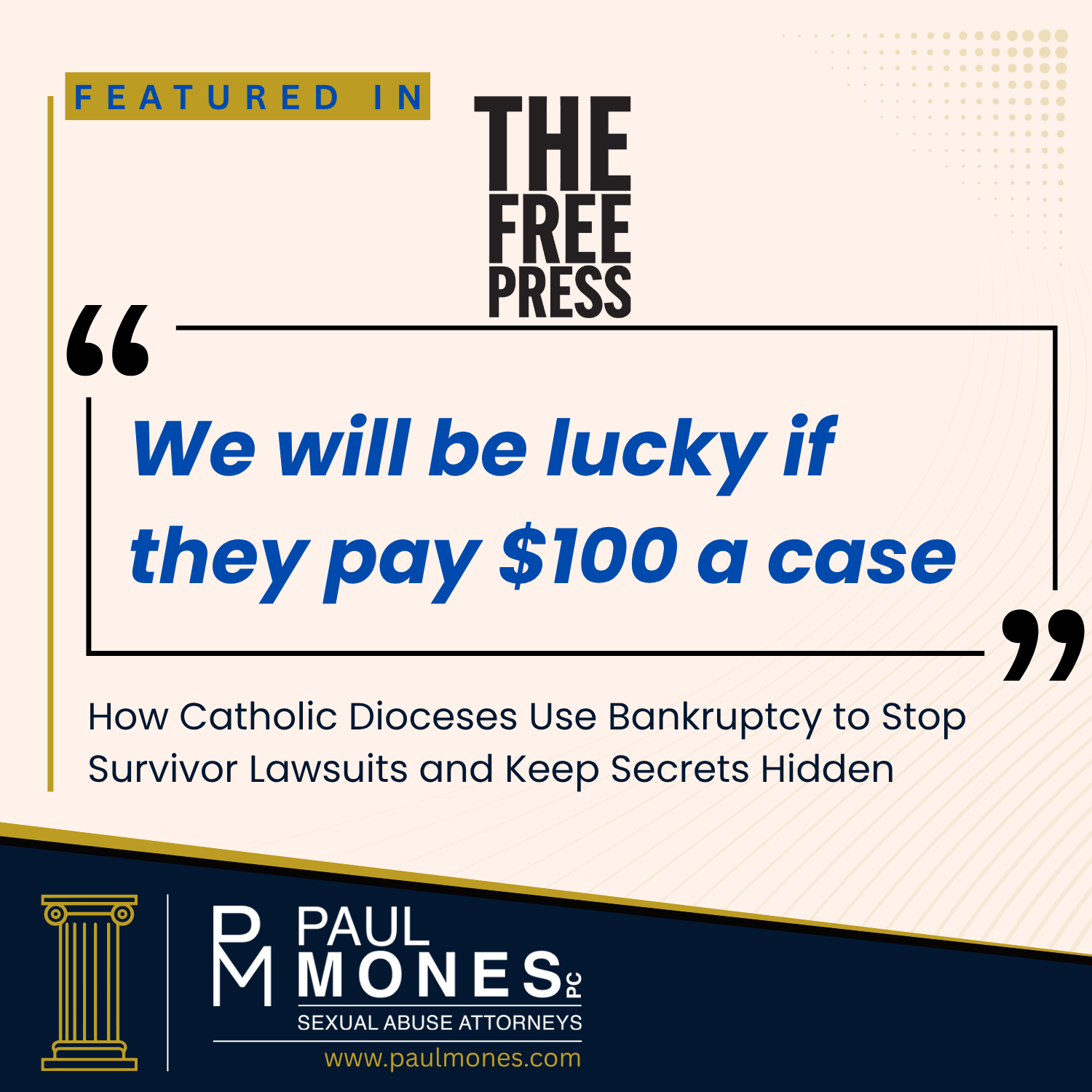
“Arrowood was the insurer for 65 to 70 percent of the Brooklyn diocese’s cases,” Paul Mones noted, highlighting the bleak reality currently confronting survivors. “We will be lucky if they pay $100 a case.”
Keeping the Fight for Accountability Alive
The institutional abuse crisis did not magically come to an end when the legislative look-back windows closed or when corporate bankruptcy petitions were formally filed. Instead, the battleground simply shifted into a highly technical, specialized federal courtroom under a structured clergy sex abuse bankruptcy.
While the architecture of the bankruptcy system is currently being leveraged by powerful entities to shield institutional wealth and bury historical truths, experienced legal advocates refuse to let these corporate tactics go unchallenged. The systematic effort to conceal data inside courtrooms proves that the fight for institutional transparency, the forced release of internal “secret files,” and true survivor vindication is more critical today than it has ever been.
If your case is stalled due to a clergy sex abuse bankruptcy, specialized representation can help preserve your legal interests.
Seeking True Justice and Accountability
If you or a loved one is a survivor of childhood sexual abuse by a member of the clergy, an institutional leader, or within a youth organization, do not assume your legal window for justice has closed. Legal landscapes are constantly evolving, and powerful institutions must be held accountable for the damage they caused.
Contact Paul Mones, PC today for a confidential, compassionate, and free case consultation.