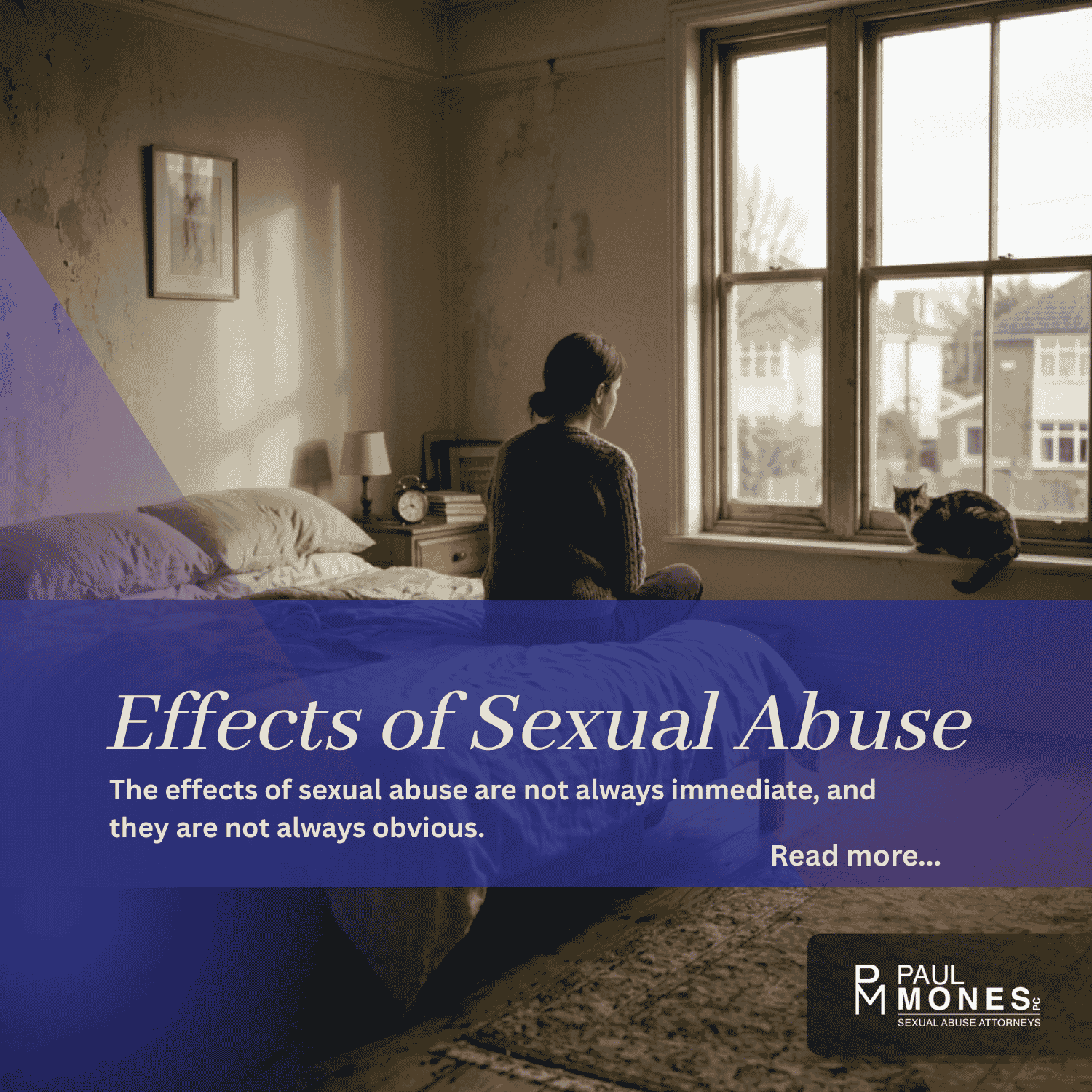
The effects of sexual abuse are not always immediate, and they are not always obvious.
For many people, the impact unfolds over time. What happened may not have been fully understood in the moment. It may have been minimized, normalized, or pushed aside in order to move forward. But the body and mind do not simply move on because something has been ignored.
The effects often show up later, sometimes in ways that do not seem directly connected at first.
There is a common assumption that the effects of abuse are always dramatic or visible. That is not how most people experience it.
In many cases, the impact is subtle at first. It may show up as discomfort in certain situations, difficulty trusting people, or a sense that something feels off without a clear explanation. Over time, those patterns can become more defined.
What matters is not whether the reaction matches a specific expectation. What matters is that the experience had an impact, even if that impact is still being understood.
The emotional impact of abuse can take many forms, and it does not follow a single pattern.
Some people experience anxiety or a persistent sense of unease. Others struggle with depression, emotional numbness, or difficulty feeling connected to themselves or to other people. There may be a tendency to avoid certain situations or relationships without fully understanding why.
For some, there is a constant internal questioning. A need to make sense of what happened, to revisit it, or to try to reconcile it with how it was perceived at the time.
These responses are not random. They are often tied to experiences that were never fully processed or understood.
The effects of abuse often show up in behavior long before they are recognized as connected to the original experience.
This can include difficulty setting boundaries, a tendency to prioritize other people’s needs over one’s own, or a pattern of entering relationships that feel familiar but not necessarily safe.
There may also be avoidance. Avoiding certain environments, conversations, or even thoughts that feel connected to something that has not been fully identified.
These patterns are often adaptive at first. They serve a purpose. But over time, they can become limiting.
The body often carries the impact of experiences that have not been fully processed.
This can show up in ways that feel disconnected from the original event. Chronic stress, tension, fatigue, sleep disruption, or physical discomfort without a clear medical explanation are all commonly reported.
In some cases, there are more specific symptoms tied to anxiety or long-term stress. The body remains in a heightened state of awareness, even when there is no immediate threat.
These responses are not imagined. They are a reflection of how the body adapts to and stores difficult experiences over time.
One of the most difficult aspects of this is that the connection between the experience and its effects is not always obvious.
If something was not clearly identified as abuse at the time, there is no reason to expect that the effects would be immediately linked to it later. People often look for a single cause, a single moment that explains everything.
But in many cases, the impact is cumulative. It builds over time, just as the original experience did.
That is why it can take years, sometimes decades, for someone to begin to connect what they are feeling with what they went through.
For many people, there is a point where something shifts.
It may be triggered by a specific event, a conversation, a change in life circumstances, or simply a growing awareness that something does not feel resolved. What was once pushed aside starts to come back into focus.
That process can be unsettling. It can also be the beginning of understanding.
Recognizing the effects does not require having all the answers. It simply means acknowledging that what happened may have had a deeper impact than was originally understood.
The effects of abuse are not just personal. In many cases, they are part of what gives the situation legal significance.
The law recognizes that abuse does not always result in immediate action or immediate understanding. Delayed recognition, evolving awareness, and long-term impact are all common in these cases.
Understanding how the experience has affected you can be an important part of understanding whether there may be legal options available.
Each situation is different, but the effects themselves often help provide the context that was missing at the time.
If any part of this feels familiar, you are not alone in that experience.
Many people spend years trying to make sense of something that was never clearly explained or acknowledged. The effects are real, even if they are still being understood.
You do not need to have a complete understanding before speaking with someone. The first step is simply having a conversation and getting clarity.
Speak With Paul Mones & His Team of Sexual Abuse Lawyers
For more than 40 years, Paul Mones has represented survivors of child sexual abuse and has helped uncover how these patterns develop inside trusted institutions. If you have questions about something that happened, or something that does not feel right, you can start by understanding your options.
Loading
Form successfully restored
The form has been restored from your last edit. If wish to start over, please click the button
Your message has been sent!
Thank you %NAME% for taking time to send us a message. We will contact you shortly.
We have also attached a copy of your submission.
Server Side Error
We faced problems while connecting to the server or receiving data from the server. Please wait for a few seconds and try again.
If the problem persists, then check your internet connectivity. If all other sites open fine, then please contact the administrator of this website with the following information.
Can a church or place of worship be held civilly liable for clergy misconduct? Discover how religious organization sexual abuse liability claims examine negligent hiring, supervision failures, secret archives, and notice standards to hold faith institutions accountable.
What happens when a trusted institution fails to protect a child? Learn how institutional betrayal childhood sexual abuse deepens trauma through denial, reputation protection, and retaliation, and discover how trauma-informed frameworks support survivor recovery.
Can a civil abuse claim succeed without physical evidence? Discover how childhood sexual abuse lawsuit evidence uses survivor testimony, internal institutional files, outcry witnesses, and expert analysis to build a compelling civil case.
This website uses cookies to improve your experience. If you continue to use this site, you agree with it. Privacy Policy