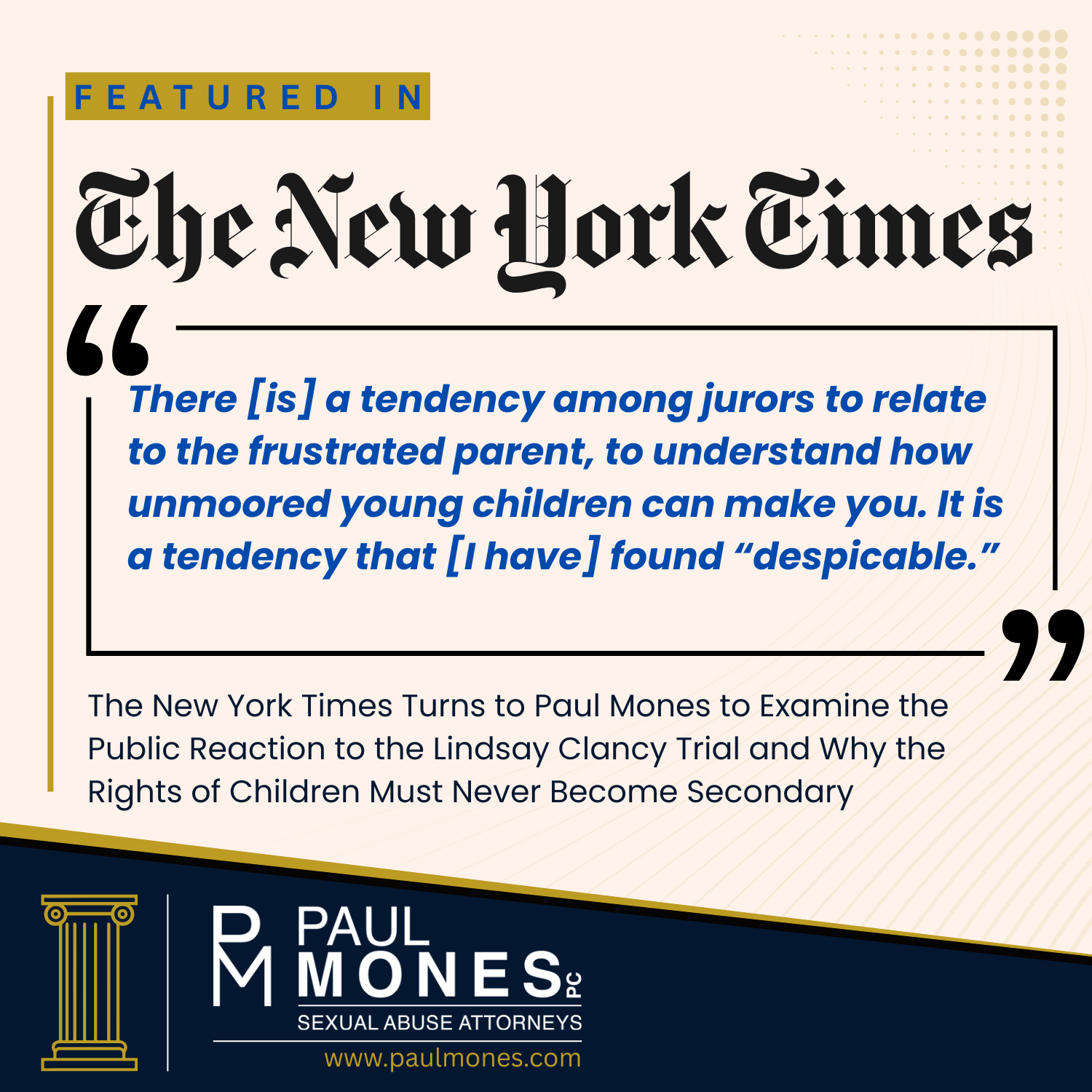
Attorney and longtime children’s rights advocate Paul Mones was recently interviewed by The New York Times for an analysis of the public reaction surrounding the murder trial of Lindsay Clancy, the Massachusetts mother accused of killing her three young children.
The article marks the second time in the past six months that The New York Times has turned to Mones for his perspective on issues involving child abuse and the rights and welfare of children, reflecting his decades of experience advocating for children and survivors of abuse.
The August 27, 2026 New York Times article, “Support for Lindsay Clancy, From Pink T-Shirts to Conservative Stars,” examines the extraordinary public sympathy Clancy has received and the difficult questions that arise when violence against children intersects with severe mental illness.
Clancy’s defense has argued that she was suffering from postpartum psychosis when she killed her three children, Cora, 5, Dawson, 3, and Callan, 8 months. Her attorneys have also argued that failures in her psychiatric treatment and medication contributed to her mental state.
The case has generated intense national attention. Hundreds of people have gathered outside the courthouse in Plymouth, Massachusetts, in support of Clancy, while supporters on social media have argued that failures in the mental health care system should be considered when judging what happened.
The New York Times examined not only that support, but a more difficult question: How should society respond when sympathy for the psychological suffering of a parent risks overshadowing the children who were killed?
Paul Mones: The Children Cannot Become Secondary
For more than four decades, Paul Mones has worked on cases involving children, abuse, violence, and the institutions responsible for protecting them.
The New York Times turned to Mones for his perspective on how jurors can respond when confronted with a parent accused of killing a child.
Mr. Mones told the Times that in cases like this, jurors can sometimes relate to the frustrated parent and understand how overwhelming raising young children can become.
He described that tendency as “despicable.”
His observation raises an important issue that can easily become lost in cases dominated by questions about a defendant’s mental health: whatever explanation may ultimately exist for the defendant’s actions, the children themselves remain the victims.
Cora, Dawson and Callan Clancy were five years old, three years old and eight months old.
They had no control over the circumstances surrounding their deaths.
Mental Illness and the Rights of Children Are Different Questions
The Clancy case presents extraordinarily difficult questions about mental illness and criminal responsibility.
Her defense maintains that postpartum psychosis and problems with her psychiatric treatment profoundly affected her ability to understand her actions. Prosecutors have challenged that account and presented evidence intended to show that Clancy understood what she was doing.
Those are questions for the jury.
But acknowledging the seriousness of mental illness does not require society to minimize what happened to the children.
Public discussion surrounding cases involving parents who kill their children can sometimes shift almost entirely toward the parent: What was the parent experiencing? What pressures were they under? Did the medical system fail them? Could someone have intervened?
Those can all be legitimate questions.
There is another question that deserves equal attention: What about the children?
Children are uniquely dependent on adults for their safety. They cannot choose their parents, remove themselves from dangerous homes or navigate the institutions that are supposed to protect them.
Their rights and their vulnerability cannot become secondary simply because the circumstances surrounding their deaths are complicated.
A Lifetime of Advocacy for Children and Abuse Survivors
Paul Mones’ perspective comes from decades of legal work involving the rights and protection of children.
Over more than 40 years, Mones has represented survivors of child sexual abuse and pursued cases involving powerful organizations and institutions. His work has included litigation involving religious institutions, youth organizations and other entities entrusted with the safety of children.
That experience has repeatedly confronted him with a fundamental principle: adults and institutions entrusted with children carry an extraordinary responsibility to protect them.
When that protection fails, understanding why it failed matters.
So does remembering who suffered the consequences.
The Lindsay Clancy trial will ultimately require jurors to decide difficult questions about mental illness, criminal responsibility and the insanity defense.
The broader public conversation raises another issue.
Compassion for mental illness and concern about failures within the mental health system can coexist with an unwavering recognition of the rights of children.
Those children should never disappear from the story.