Cracking the Vault: How the Kerry Lewis Verdict Transformed Youth Organization Sexual Abuse Litigation
For decades, national youth programs operated under an aura of absolute public trust. Parents viewed these groups as safe spaces for leadership, outdoor education, and character development. However, beneath the surface of several major youth networks lay a deeply organized system of record-keeping designed to document internal sexual misconduct allegations while actively hiding them from law enforcement and the public. In personal injury law, breaking through this protective corporate wall requires navigating the highly specialized terrain of youth organization sexual abuse litigation—a field that was permanently altered by a historic trial in Portland, Oregon.
Historically, non-profit youth entities insulated themselves from broad systemic liability by blaming local volunteers, utilizing short statute of limitations windows, and asserting that national leadership lacked direct supervisory control over local chapters. Today, that playbook is failing. By uncovering hidden corporate records, specialized trial teams are successfully demonstrating that national organizations knew about widespread risks and chose institutional secrecy over the active protection of children.
The Portland Precedent: The Kerry Lewis Verdict
The changing dynamics of youth organization sexual abuse litigation are clearly visible in the landmark case of Kerry Lewis v. Boy Scouts of America. An Oregon jury delivered an embarrassing and decisive rebuke to the national organization, finding it highly negligent in its failure to protect a young boy from repeated sexual abuse by an assistant Scoutmaster, Timur Dykes, during the early 1980s.
The facts uncovered during discovery illustrated a severe breakdown in safety protocols:
- Early 1983: The assistant Scoutmaster admitted to a regional church bishop that he had molested 17 Boy Scouts.
- Ongoing Association: Despite these admissions, the national organization and its local council allowed the predator to continue associating with the victim’s troop.
- Criminal Convictions: The perpetrator was subsequently convicted three times of separate abuse charges involving boys, eventually serving extensive prison sentences.
The jury awarded Kerry Lewis, who filed the suit at age 38, $1.4 million in compensatory damages. More importantly, the panel found the national organization liable for up to $25 million in punitive damages, to be determined in a separate phase of the trial. The verdict divided financial fault among the entities involved, assigning 60 percent ($840,000) of the immediate compensatory judgment directly to the national Boy Scouts organization, 15 percent ($210,000) to the Cascade Pacific Council, and 25 percent ($350,000) to the chartering church, which had settled its portion prior to trial. This multi-tiered fault allocation established a major benchmark for modern youth organization sexual abuse litigation.
Weaponizing Discovery: The Opening of the “Perversion Files”
The true turning point in this historic case—and for all subsequent youth organization sexual abuse litigation—was the forced disclosure of the organization’s highly confidential personnel archives, colloquially known as the “perversion files.” For decades, the national headquarters maintained meticulous internal records of suspected and known pedophiles within their ranks, yet fought aggressively to keep these documents completely hidden from civil juries.
The legal battle over these archives reshaped the discovery process:
The Supreme Court Mandate
Prior to the Portland trial, the Oregon Supreme Court issued a historic ruling approving the release of more than 1,000 confidential files documenting alleged abusers from 1965 to mid-1984. This set a critical precedent for youth organization sexual abuse litigation, proving that internal corporate archives are discoverable if they show a historical pattern of hiding known threats.
The Institutional Deception Framework
Plaintiffs’ counsel, including trial attorney Kelly Clark, used these files to demonstrate that the organization did not use its internal data to protect children, but rather to protect itself from public scandal. By proving the archives were kept secret from local parents, the legal team turned a standard negligence claim into a multi-million-dollar punitive damages case.
Overturning the “Local Volunteer” Defense
Defense attorneys argued that the national office relied entirely on local volunteers to supervise children and take disciplinary action. However, the introduction of the secret files completely dismantled this defense in youth organization sexual abuse litigation, showing that national executives exercised top-down control over the tracking and concealment of regional abuse complaints.
The Legacy of Strict Lookback Legislation
A central theme in modern youth organization sexual abuse litigation is the critical role of legislative lookback windows. In the Kerry Lewis matter, the abuse occurred in the early 1980s, yet the trial did not occur until 2010. Under traditional statutory deadlines, historical claims of this nature were routinely dismissed out of court due to the passage of time.
When states open temporary lookback windows, they allow historical survivors to bring old claims into modern courtrooms. This enables trial teams to combine decades-old events with modern corporate data, exposing how institutions consistently failed to act on internal warnings. This shifting legal landscape ensures that old cover-ups can still result in modern financial liability.
A New Framework for Institutional Accountability
The fallout from the Portland verdict continues to guide modern risk management across all youth-focused non-profits, sports leagues, and religious groups. Historically, national boards could hide behind corporate layers or blame rogue individuals. Modern youth organization sexual abuse litigation has eliminated that isolation strategy.
Today, plaintiffs’ firms routinely use the discovery strategies pioneered by Paul Mones and his colleagues to pierce corporate structures. By demonstrating that a national organization’s failure to deploy its internal data constitutes a reckless disregard for human safety, modern lawsuits are forcing youth networks to adopt total transparency, implement independent background vetting, and acknowledge that hiding past misconduct creates an unmanageable financial liability.
Secure Elite Counsel to Evaluate Your Institutional Claim
Navigating a complex civil claim against a national youth program or non-profit network requires specialized, aggressive legal advocacy to break through corporate shields. If you or a loved one need to evaluate a historical claim involving an after-school program, a summer camp, a sports league, or a faith-based youth group under the evolving guidelines of youth organization sexual abuse litigation, securing experienced counsel is a critical first step. Our trial firm remains completely committed to exposing institutional cover-ups, auditing hidden personnel files, and ensuring your family receives a comprehensive legal evaluation.
For more information about youth organization sexual abuse litigation, Contact Paul Mones, PC today to schedule a completely confidential, free case consultation.
Source Information
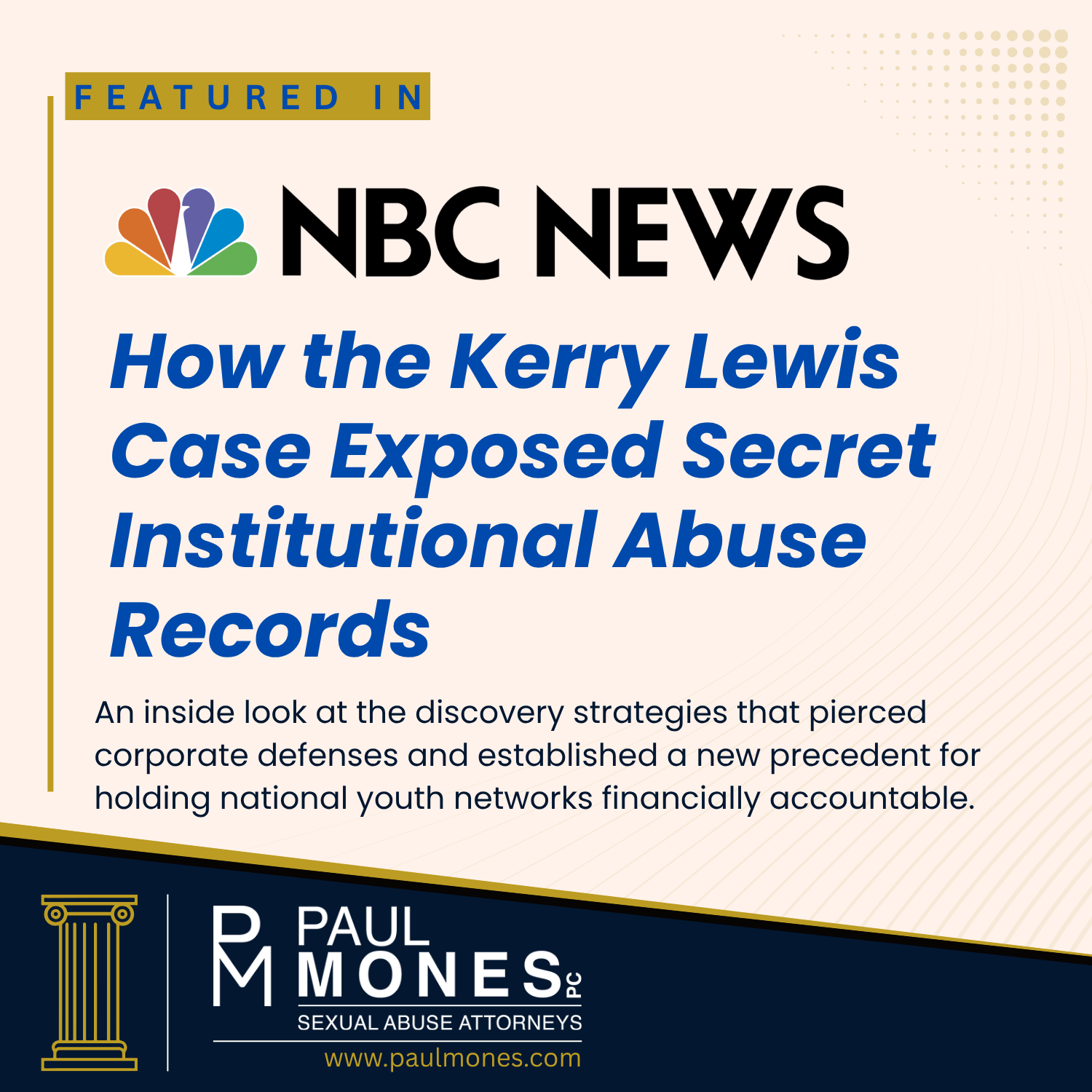
To review the primary investigative reporting, analyze the original multi-million dollar verdict metrics, and read the complete journalistic breakdown surrounding this national legal wave, look at the comprehensive report published by The Associated Press via NBC News here.