The Scouting Abuse Settlement Trust Crisis: Why Survivors Are Still Waiting for Justice
For decades, tens of thousands of men carried the invisible, crushing weight of childhood trauma inflicted within an organization meant to protect them. When states across the nation began passing progressive look-back windows to lift outdated civil statutes of limitations, it seemed a reckoning had finally arrived for the Boy Scouts of America (now rebranded as Scouting America).
Faced with an unprecedented wave of impending civil litigation, the youth organization chose a familiar institutional exit ramp: filing for Chapter 11 bankruptcy protection.
The resulting $2.46 billion bankruptcy resolution took official effect in 2023, giving life to one of the largest child sexual abuse compensation funds in United States history: the scouting abuse settlement trust.
Yet, a deeply troubling investigative report by Bloomberg Law reveals that for the more than 60,000 middle-aged and elderly survivors seeking validation, this massive financial fund has turned into an agonizing administrative bottleneck. Over two years after its inception, the scouting abuse settlement trust has successfully distributed funds to only about half of the total qualified claimants.
Even worse, thousands of aging survivors who were formally notified that their claims were valued at hundreds of thousands of dollars have received less than 2% of those promised amounts as the trust remains ensnared in complex appeals, institutional insurance stalemates, and deep funding deficits.
A Fatal Flaw: Promising Values the Fund Cannot Pay
Unlike standard point-based mass tort funds—which assign abstract numerical values to injuries and distribute money only after a final dollar pool is secured—the scouting abuse settlement trust took a highly unusual and problematic reverse approach. The trust proactively assigned specific cash values to different tiers of abuse before ensuring the money actually existed to back them up.
The tiered scale of the scouting abuse settlement trust places rape at the absolute apex, carrying a baseline valuation of $600,000 that can scale up to $2.7 million depending on aggravating factors such as the profile of the perpetrator or long-term psychological impact.
However, administrators admit that the trust has already processed verified claims totaling a staggering $7 billion. This is nearly three times the total maximum amount of cash currently available within the settlement fund.
Consequently, trust administrators have issued stark warnings to claimants stating that final payouts “almost certainly will not” match the initial monetary evaluations survivors were told their claims were worth.
The Geography of Justice: How State Boundary Lines Suppress Payouts
One of the most uniquely devastating elements of the scouting abuse settlement trust is how it handles state-level legal variations. Because the scouting organization operated as a unified nationwide entity, boys were subjected to the exact same predatory behavior regardless of geography. However, the trust’s structural framework forces it to heavily penalize survivors based on the specific state where the historic crimes occurred.
If a survivor was abused in a progressive state that passed comprehensive look-back legislation (like New York or California), their claim within the scouting abuse settlement trust retains its full baseline value of $600,000 or more.
But if that exact same act of horrific abuse took place in a state with restrictive, outdated laws (like Oklahoma or Kansas), the trust is legally required to slash the claim value down to as low as $33,000 because the claim would technically be inadmissible in a local civil court.
This geographic disparity highlights an ongoing institutional failure to view child protection through a modern lens.
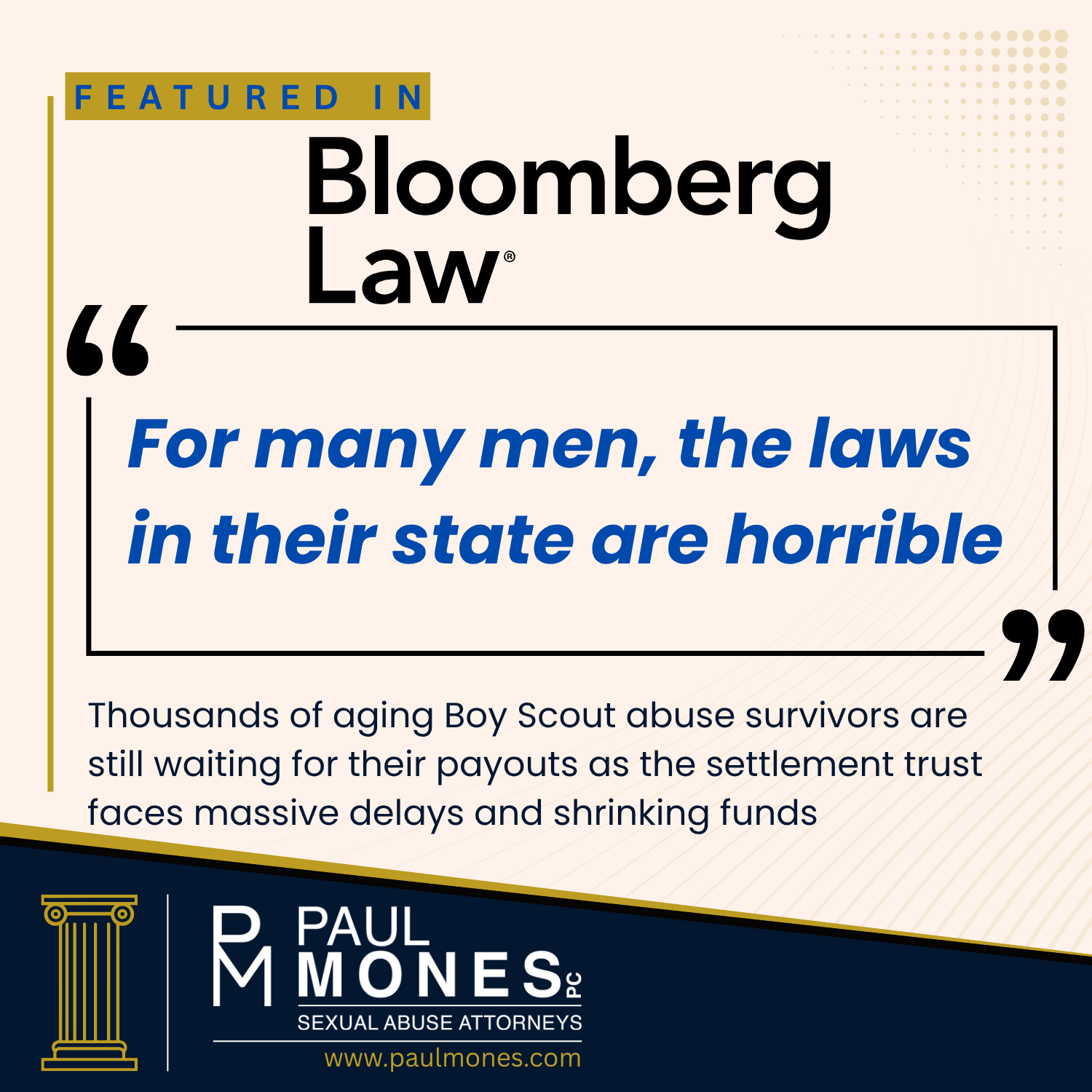
“For many men, the laws in their state are horrible,” points out Paul Mones, a nationally recognized plaintiff’s attorney who represents roughly 250 ex-scouts trapped in this process. “There’s only a handful of states that have come into the 21st century and realized it takes a long time to come forward.”
Weaponized Attrition: Running Out the Clock on Aging Survivors
For an institutional debtor navigating a massive historical abuse scandal, time is a powerful financial asset. The processing delay plaguing the scouting abuse settlement trust is rapidly turning into an existential race against the clock for its aging claimant population.
According to federal court records filed by the settlement trustee, Barbara Houser, more than a third of the entire surviving claimant pool is currently 65 years of age or older. Crucially, over 2,300 claimants are past the age of 80.
As the trust slowly grinds through its remaining backlog of nearly 20,000 unreviewed files, survivors are quite literally dying in the shadows while waiting for simple validation. Court records show that more than 2,000 abuse claimants have already passed away since the initial bankruptcy proceedings began, the vast majority without ever receiving their promised compensation.
This biological clock represents an ongoing tragedy that plaintiff attorneys see firsthand within their private practices every single month.
Paul Mones notes that most specialized attorneys intimately involved in managing these individual claims have unfortunately watched between 5% to 8% of their entire client base pass away since this administrative claim process first launched.
When an elderly survivor dies before their claim is completely adjudicated and paid out by the scouting abuse settlement trust, it complicates or outright diminishes the ultimate recovery, saving the institutional fund money at the absolute expense of human closure.
The $4 Billion War Against Corporate Insurance Carriers
The ultimate survival and efficacy of the scouting abuse settlement trust hangs entirely on a highly complex, multi-year legal battle against roughly 90 resistant insurance companies.
While the trust currently holds access to a portion of its baseline $2.46 billion funding pool, that amount is nowhere near sufficient to cover the true value of the verified trauma. To bridge the massive multibillion-dollar deficit, the bankruptcy trustee must aggressively litigate against corporate insurance providers who are fiercely fighting back in court to avoid paying out an estimated $4 billion in extra coverage.
These corporate insurance carriers are attempting to completely absolve themselves of financial liability by questioning the trust’s internal valuation methods and claim verification processes. Unless the trust can successfully wring these billions out of resistant insurers through incredibly dense coverage litigation, the final payouts distributed to individual survivors will remain a microscopic fraction of what they are rightfully owed. Trust officials openly acknowledge that this secondary insurance war could easily drag on for years to come.
Shattered Trust and the Long Road Ahead
The ongoing implementation of the scouting abuse settlement trust has left thousands of men feeling deeply anxious, isolated, and profoundly disillusioned by the American legal system. Instead of experiencing a swift, compassionate ending to a lifelong nightmare, survivors are forced to navigate digital forums and legal dockets just to figure out if they will survive long enough to see true institutional accountability.
The institutional abuse crisis did not conclude when the scouting organization reorganized its corporate structure. True healing requires that these multi-billion dollar entities stop hiding behind complex legal extensions and bankruptcy maneuvers. For survivors everywhere, the fight to ensure the scouting abuse settlement trust fulfills its moral and financial obligations is an urgent battle for dignity that cannot afford further delay.
Secure Experienced, Compassionate Legal Advocacy
If you or someone you love is a survivor of historical childhood abuse within an institution, scouting group, or youth organization, your voice deserves to be heard without administrative minimization. Navigating complex institutional trusts requires an advocate who understands how to push back against institutional delays.
For more information about scouting abuse settlement trust, Contact Paul Mones, PC today for a fully confidential, compassionate, and free case consultation.